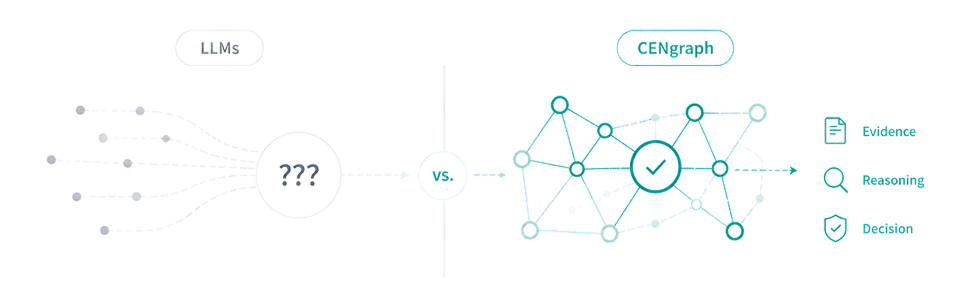
Most clinical AI systems are black box wrappers, dressed up as solutions.
CENgraph is different.
CENgraph helps clinicians move from uncertainty to action with recommendations they can understand, verify, and trust.
FDA Glass-Box Compliant
Explainable by Design
Fully Auditable
The Limits of Black-Box AI
Language models hallucinate.
They can be “prompt engineered” within limits.
Their reasoning can never be audited reliably.
And regulators are catching up fast.
Built Different. Built for Clinical Trust.
CENgraph was built from first principles.
A neurosymbolic architecture, a deterministic Clinical Reasoning Engine traversing a proprietary Curated Knowledge Graph produces outputs that are explainable, reproducible, and fully traceable.
No probabilistic inference.
No black-box reasoning.
Every clinical conclusion is the product of structured
graph traversal and evidence-based scoring.
Clinical decision support requires more than language prediction.
Probabilistic inference is inherently unreliable at the individual patient level. The LLMs are inherently stochastic in nature, leading to different answers to the same data if the question is asked a different way. Population-level prediction cannot replace patient-specific reasoning. Outputs that cannot be traced cannot be trusted, and outputs that cannot be trusted cannot be acted upon.
The regulatory reality is accelerating this reckoning. FDA scrutiny of AI-enabled clinical tools is intensifying. Tools built on opaque inference models face an increasingly hostile compliance environment.
Explainable. Reproducible. Fully traceable.
That’s not a feature set; it’s an architecture.
HOW IT WORKS
The
CENgraph workflow
step-by-step.
1
Natural-language input
The clinician inputs patient information in natural language: demographics, symptoms, comorbidities, lab results, medications, and procedures through a natural-language prompt interface. No rigid forms. No separate application. No disruption to the existing consult pattern.
2
Structured parsing and graph traversal
The Clinical Reasoning Engine parses the natural-language input into structured clinical data and traverses the Curated Knowledge Graph, a richly connected, evidence-based biomedical knowledge base constructed from peer-reviewed clinical literature and treatment guidelines. The patient’s profile is mapped against the evidence base through structured graph traversal and evidence-based scoring, not inference.
3
Ranked, sourced, traceable output
CENgraph returns a ranked list of differential diagnoses and prioritised treatment options. Every output is linked to specific source evidence. The complete reasoning trace is accessible on demand. No black boxes. No unexplained conclusions.
4
Clinical review and decision
The clinician evaluates, revises, and finalises every recommendation. CENgraph supports the decision; it does not make it. Clinical judgment remains entirely and unambiguously with the physician. This is not a compliance position; it is a design principle.
THE TECHNICAL MOAT
Why this architecture is difficult to replicate.
Neurosymbolic design
deterministic reasoning engine combined with a structured knowledge graph. Neither element alone is the moat; the combination is.
Proprietary Curated Knowledge Graph
built from peer-reviewed medical literature and clinical guidelines. Not a commodity resource. Not replicable without equivalent domain expertise and curation investment.
FDA Glass Box compliance from inception
not retrofitted. The architecture was designed for auditability. That design choice is now a structural advantage as regulatory scrutiny intensifies.
4 patents in preparation
covering the architecture and key methodological innovations.
Clinical workflow integration
high switching costs once adopted. Zero-friction onboarding removes the barrier to first adoption.
KEY CLINICAL FEATURES
What CENgraph delivers at the point of care
Ranked differential diagnoses
Prioritised by clinical relevance to the specific patient presentation.
Prioritised care pathways
Recommended testing, follow-up assessments, and treatment options.
Source-linked outputs
Every conclusion tied to specific peer-reviewed evidence.
On-demand reasoning trace
Full auditability, available at any point in the workflow.
Fully traceable outputs
Deterministic outputs that cannot generate clinically unsupported
conclusions.
Measurable outcomes
Increases in accepted preventative procedures measurable from
week one.
USE CASES
Where CENgraph delivers.
Longevity and concierge care clinics — complex, multi-comorbidity presentations
Healthcare workflows — surfacing recommended testing before problems escalate
High-volume primary care — reducing cognitive burden at scale